Categories
Updates

The New Public Charge Rule: What Changes on September 18, 2026 – And Why It Matters

Share this:

On July 16, 2026, the Department of Homeland Security finalized a rule rescinding the Biden administration’s 2022 public charge regulation. The change restores “Congressional intent that aliens in the United States be self-reliant.” For the roughly one million people who file Form I-485 each year to adjust status to lawful permanent residence, the change is significant— it reshapes one of the most consequential, and least predictable, tests in the green card process. Here’s what’s actually changing, who is likely to be affected by it, and why we anticipate that that this new public charge rule opens the door to inconsistent and potentially arbitrary decision-making.
What Is “Public Charge”?

Section 212(a)(4) of the Immigration and Nationality Act makes a person inadmissible — and therefore ineligible for a green card or visa — if they are deemed “likely at any time to become a public charge.” An application for immigrant visa through adjustment of status or consular processing may be denied if there is a finding that the applicant is likely to become a public charge.  But what does public charge really mean? The term itself is not defined in the statute. Through USCIS regulations and case precedents, it has been defined, redefined, and litigated over for more than a century, most dramatically during the last decade: a narrow Clinton-era definition, a sharply expanded 2019 Trump-era rule (blocked in courts and later withdrawn), and then the 2022 Biden rule that restored the narrower, pre-2019 approach. The 2026 Trump rule now rescinds that 2022 framework — but unlike its predecessors, it doesn’t replace it with a new detailed definition. It simply removes the guardrails.

The 2022 Rule: A Narrow, Defined Test

To understand the change, let’s revisit the Biden’s 2022 Rule which is rescinded. Under the 2022 rule, “public charge” meant a very specific thing: someone likely to become primarily dependent on the government for subsistence. That dependence could only be shown two ways:

  • Receipt of public cash assistance for income maintenance — programs like SSI or TANF, and
  • Long-term institutionalization at government expense.

Everything else was off the table. Medicaid, SNAP (food stamps), housing assistance, and other non-cash or supplemental benefits could not be counted against the visa applicant.

Benefits received by other household members didn’t count against the applicant either. The rule also explicitly declined to designate any single factor as “heavily weighted,” and it built in defined exemptions and procedural clarity — applicants and attorneys knew, with reasonable confidence, what would and would not be scrutinized.

The 2026 Rule: Discretion Without a Defined Standard

The new rule strips out the 2022 framework in its entirety — the definition, the structured list of considered benefits, and the codified exemptions and waivers. In their place, USCIS is directed to conduct a “totality of the circumstances” review using the statutory factors already listed in the INA: age, health, family status, financial resources, and education/skills. Key changes:

No more “primarily dependent” standard. Officers are no longer bound to a specific dependency threshold; they can weigh any factor they consider relevant to self-sufficiency.

Any means-tested benefit is fair game. Rather than limiting review to cash assistance and institutionalization, officers may now consider receipt of any means-tested public benefit — including non-cash programs like Medicaid or SNAP — received on or after the rule’s effective date.

No replacement definition. DHS isn’t issuing a new detailed rule to take the 2022 rule’s place. Adjudicators will rely on the bare statutory language, past precedent decisions, and “policy guidance” the agency has not yet released.

A revised Form I-485. USCIS will publish a new version of the form; older versions submitted or postmarked on or after September 18, 2026, will be rejected outright.

Tougher bond terms. Any public charge bond posted on or after the effective date will be considered breached if the bonded individual receives any means-tested benefit before death, permanent departure, or naturalization — or is otherwise found noncompliant with bond conditions.

Affidavit of Support unchanged. Form I-864 remains required for most family-based and some employment-based cases, and will continue to factor into the totality-of-circumstances review.

Statutory exemptions remain. Refugees, asylees, Special Immigrant Juveniles, and T/U nonimmigrant and VAWA beneficiaries, among others, are still statutorily exempt from public charge review.

Who Is Likely to Be Affected

The people most exposed under the new framework are those the 2022 rule was specifically designed to protect:

Lower- and middle-income applicants adjusting status through family sponsorship, whose households may have used Medicaid, SNAP, or housing assistance at some point — benefits that were previously irrelevant to their case and now may not be.

Applicants with elderly, disabled, or chronically ill family members, since health and prior institutional care can again be weighed more heavily.

Mixed-status and mixed-benefit households, where a US citizen child’s use of Medicaid or SNAP could indirectly color an officer’s view of the household’s overall financial self-sufficiency, even though the applicant themselves isn’t the benefit recipient.

Employment-based applicants in lower-wage occupations or with large families, where income-to-household-size ratios may be scrutinized more subjectively.

Anyone who used benefits in the gap period before new guidance is issued — since DHS has not clarified how reliance on the 2022 rule’s protections between now and September 18 will be treated going forward.

Steps to Consider Now

1. File before September 18, 2026, if you’re eligible and ready. If your case is otherwise complete, filing under the current 2022 framework may be advantageous, since the new discretionary standard won’t apply to applications filed before the effective date.

2. Use the correct Form I-485 version. Once USCIS publishes the revised form, older versions submitted on or after the effective date will be rejected outright — confirm you’re using the current version before filing.

3. Review your household’s benefit history with your attorney. If anyone in your household — including the applicant — has received means-tested benefits, discuss now how that history might be viewed under the new standard, and whether documentation of eligibility, need, or duration should be prepared in advance.

4. Prepare a well documented Affidavit of Support. Since Form I-864 remains a required and heavily weighed factor, ensure sponsors meet income thresholds and have documentation ready, since financial evidence will matter even more under a broader discretionary review.

5. Don’t disenroll from benefits your household is legally exempt from or entitled to without professional advice first. Fear-driven withdrawal from benefits — especially for exempt categories like US citizen children — can create financial hardship without necessarily improving your case; talk to an immigration attorney before making that decision.

6. Watch for USCIS policy guidance. As interim guidance is released ahead of September 18, revisit your case strategy — the practical scope of “totality of the circumstances” will become clearer as that guidance is published.

7. Consult an immigration attorney about timing and evidence strategy specific to your case. Because outcomes under the new rule may vary based on individual officer discretion, a case-specific risk assessment is more valuable now than ever.

More Scrutiny on Green Card Applications

The new rule means broad USCIS officer discretion with no clear replacement standard. It is anticipated that there will be closer scrutiny of benefits use, more requests for evidence and less certainty about how any two cases-even similar ones-will be decided. If ready and eligible it is advisable to file adjustment applications before the effectivity date.  However, careful attention should be given to reviewing your case against the May 21, 2026 policy on adjustment of status before filing.

If you have questions about how this ruling affects your family’s specific situation, please contact our office to schedule a consultation. We may be reached at 1 415 397 0808, law@tancinco.com or through our website: www.tancinco.com.

Categories
Updates

Public charge rule: One step closer to being overturned

Share this:

The Senate passed a resolution on May 17, 2023, to overturn the Biden administration public charge rule which made it more difficult for immigrants to obtain legal status if they used certain public benefits.

The resolution, which was sponsored by Senator Roger Marshall (R-KS), passed by a vote of 50-47. 

Two Democrats, Joe Manchin of West Virginia and Jon Tester of Montana, joined all 50 Republicans in voting for the resolution.

The resolution now moves to the House of Representatives, where it is expected to pass. 

If it is passed by the House and signed into law by President Biden, the public charge rule will be overturned.

Why this matters for aspiring permanent residents

The overturning of the public charge rule would be a major victory for aspiring permanent residents. 

The rule made it more difficult for immigrants to obtain legal status if they used certain public benefits, such as food stamps, Medicaid, and housing assistance. This disproportionately impacted low-income immigrants, who are more likely to use these benefits.

The overturning of the public charge rule would make it easier for low-income immigrants to obtain legal status. This would allow them to come out of the shadows and contribute more fully to the US economy and society.

What can you do to help?

If you are an aspiring permanent resident, there are a few things you can do to help ensure that the public charge rule is overturned.

  • Contact your elected representatives and urge them to support the resolution to overturn the public charge rule.
  • Sign petitions and join rallies in support of overturning the public charge rule.
  • Educate yourself and others about the public charge rule and its impact on immigrants.

If you need guidance on seeking permanent residence and working around this rule until it is overturned, reach out to your trusted immigration lawyer.

Categories
Updates

Latest: On Green Cards and being a “Public Charge”

Share this:

The US Citizenship and Immigration Services (USCIS) has announced changes to Form I-485 or the Form for Adjustment of Status.

The change includes a new “public charge” portion, and some new questions for green card applicants.

The changes have been applied since December 23, 2022, according to the USCIS.

First, let’s review what a public charge is. Being a public charge means that a person is “primarily dependent” on the government, making them a “charge” to the public rather than a contributor. 

Green card applicants are not admissible to the US if they are likely to be a public charge. 

The keyword is self sufficiency.

The change is with proving one’s self sufficiency. Under the Trump administration, there was a whole separate form, the Declaration of Self Sufficiency, to prove that one was not likely to become a public charge. 

Under the Biden administration, some of the information asked by the discarded form will be included in the Form I-485.

Here’s what Boundless found: In the preview of Form I-485, if an applicant answers “yes” to being subject to public charge ground of inadmissibility on their form, they must provide the following information:

  • Household size
  • Annual household income
  • Total value of household assets
  • Total value of household liabilities
  • Highest degree or level of school completed
  • List of work-related skills, certifications, licenses, educational certificates
  • If an applicant has ever received cash benefit programs for income maintenance
  • If an applicant has ever received long-term institutionalization at the government’s expense

For guidance on getting a green card and navigating these new rules, reach out to a trusted immigration lawyer.

Categories
Featured

10 Immigration Issues Important to Filipino Immigrants in 2023

Share this:

Family reunification and better economic opportunities are still the most significant considerations for immigrating to the United States. Intending immigrants or those who want to work in the United States also face several challenges. Below are just a few of the many important issues that are either beneficial or are drawbacks to Filipino immigrants.

1. Visa Backlogs and Lengthy Waits

Priority for issuance of visas  to immediate relatives of U.S. citizens is the current policy of the U.S. Department of States. So in 2022,  we have seen more visas being issued under this category which includes parents, minor children and spouses of U.S. citizens. Fiance petitions by U.S. citizens have also benefited from this priority preference.

Unfortunately, those who do not fall under this priority preference experience lengthy waits before they are called for interviews. The U.S. Department of State reported that as of December 2022, there are globally 377,953 who are classified as documentarily qualified and only 33,406 have been scheduled for interviews. The interviews are being scheduled according to date of completion of submission of documents to the National Visa Center. So the earlier the documents and forms are submitted the sooner that the visa applicant may be added to the queue,

2. Retrogression of EB3 Other Workers- “Caregivers” 

In the last couple of years, the priority dates for other workers under the third preference employment based category for Filipinos have been current. When a priority date is current, that means that visas are available. Hence, many unskilled workers including our health caregivers were issued visas under this category. Unfortunately, in May 2022 of this year, this visa category retrogressed to June 2020.. There will be a couple of more years of wait but the good news is that the filing chart allows for the processing of visa petitions with priority dates of June 2022. 

3. Registered Nurses and Physical Therapists

Registered Nurses, Physical Therapists and other allied health care workers other than those mentioned under the other workers category are still “current” for purposes of filing and final issuance of visas.  

This year, there was a proposed legislation for the elimination of the numerical per country quota. If this is going to be re-introduced again the visas under the EB3 category will be severely impacted.  Healthcare professionals looking to have their visas issued must get their applicant processed without further delay to avoid being affected by any future legislation.

4. Waiver of Interviews of Non-immigrant Visas At the U.S. Embassy

The State Department waived most nonimmigrant visa interviews for individuals renewing visas that expired in the last 4 years, and it authorized interview waivers for many work visa applicants. Included in this waiver of interview are visitor (B1/B2)  visa holders. About half of all nonimmigrant visa applicants no longer need a visa interview. This has helped to partially recover the backlog of nonimmigrant visa processing. This policy shall remain in place until December 2023.

5. Human Trafficking Awareness & Immigration Relief

In California, at least 2 cases of human trafficking and labor exploitation were filed against Filipinos. Unfortunately, their victims are also from the Philippines. The latest one is the case in San Francisco where a couple was charged with exploiting and trafficking a woman who took care of their child. Human trafficking survivors may be eligible for lawful status, employment authorization, and a potential path to permanent residency.  There has to be an awareness on the part of U.S. employers on what constitutes human trafficking and individuals must learn to assert rights against traffickers to prevent becoming victims of  inhuman and degrading  treatment by unscrupulous individuals.

On December 27, 2022, President Biden signed the “Countering Human Trafficking Act of 2022,” which codifies and expands the Department of Homeland Security’s (DHS) Center for Countering Human Trafficking (CCHT). The bill authorizes $14 million to carry out the Act and ensures that the CCHT is staffed with at least 45 employees to carry out the Department’s critical work to combat human trafficking.   

6. Public Charge Rule

In March 2021, President Biden rescinded a public charge rule that, in effect, banned most family sponsored  immigrants with low incomes. 

On December 23, 2022, a new final rule on public charge went into effect. Under the new rule, it is safe for immigrants and their families to use health, nutrition, and housing programs for which they qualify. Health care programs, including Medicaid and COVID care, housing, food programs, and many other vital services.

Only those deemed likely to be primarily dependent on cash aid for income maintenance or long-term care at government expense could be denied for public charge.

Immigrant visa applicants must consult with their legal counsel on how this new public charge rule will benefit them in their applications.

7. Availability of H2B Temporary Working Visas 

Unlike other countries,  U.S. immigration law has very  limited numbers of temporary visas that are available to non-agricultural unskilled workers. In December 2022,  Biden administration increased the numbers of H2B visas to 64,716  for Fiscal Year 2023. About 44,700 visas are allocated to returning workers who received H2B visas during the last 3 years. These additional visas are available this winter and summer of 2023.

A few years back Filipinos were banned from receiving H2B visas but this suspension has already been lifted. U.S. employers may avail this type of visa for certain temporary and seasonal occupations such as restaurant/hospitality, maintenance, construction, landscaping among others.

8. Returning Green Card Holders

Three years into the pandemic and there are still green card holders who “overstayed” in the Philippines and have not returned to the United States. Those who stayed beyond one year outside the United States are considered to have abandoned their residence unless a returning resident visa is obtained from the U.S. Embassy. Not all returning resident visa applicants are approved and it is important to obtain legal counsel to determine what factors may be raised to increase the chances of returning to the United States. 

9. Legalization or Registry

During President Biden’s first month in office, he expressed his intention to address the issue of unauthorized immigrants and he shall propose a pathway to citizenship. More than 11.5 million unauthorized immigrants are still awaiting for legalization. And because of lack of bi-partisan majority in U.S. Congress who will support this bill, no legislation has been passed yet. 

Will there be a legalization? Hopes for the passage are dwindling away..until, a proposal for a modification of registry date is seen to have offered a ray of hope. If the registry date is modified (through legislation) from 1972 to 2012, at least 6.8 million undocumented may be eligible to apply for green cards. Registry allows certain non-citizens who are long term residents of the United States, but who are either undocumented or present in the country under some sort of temporary immigration status to register as lawful permanent residents. 

10. DACA

About 28,000 Filipino DREAMERS may be eligible for an initial application for Deferred Action on Childhood Arrivals (DACA) according to the data gathered by the  Migration Policy Institute. But on October 5, 2022  the 5th Circuit Court of Appeals ruled that the DACA program was unlawful and sent the case back to the lower court to consider the Biden’s administration’s new DACA regulations On October 14, Judge Hanen partially blocked the DACA regulation from going into effect.

While DACA initiative has provided deportation protections and work authorizations to over 800,000 of people who arrived in the United states as children, this temporary solution has been hanging in the balance and faces multiple legal challenges with administrative attempts to end the program. DREAMERS were brought by their parents at a very young age and did not make the decision to come and live in the United States. They grew up and identify themselves as Americans. Giving them a path to citizenship is long overdue. Thus, this 2023,  it is more urgent for Congress  to pass a permanent solution to protect and defend our DREAMERS.

(Atty. Lourdes S. Tancinco is an immigration attorney and immigrant rights advocate based in the San Francisco Bay area and a partner at the Tancinco Law P.C.. She may be reached at law@tancinco.com, www.tancinco.com, facebook/tancincolaw, or at 1-888-930-0808)

Categories
Updates

Public charge immigrant? Biden admin rolls back Trump-era rule

Share this:

The Biden administration is moving towards loosening requirements for permanent residency which took effect under former president Donald Trump.

A new Department of Homeland Security regulation will make it easier for some immigrants to evade being disqualified from obtaining residency through the “public charge” principle.

Immigrants are labeled “public charge” if they are seen to be more of an economic burden than a contributor to the United States. 

Under president Trump, the government expanded the definition of benefits so that these could be used against immigrants seeking permanent residency.

With the new regulation – which is coming this December 23, 2022 – the United States Citizenship and Immigration Services (USCIS) will only consider immigrants as “public charge” if “they are likely at any time to become primarily dependent on the government for subsistence.”

While it is months away, the Biden administration has stopped enforcing the public charge rules since the beginning of its term. With the upcoming regulation, the fear of many immigrants who could be labeled as public charge will be abated.

On one hand, the Trump administration then argued that their policy would push immigrants to work harder, but advocates have condemned the policy as too harsh for the vulnerable immigrant population.

There are hundreds of thousands of immigrants who seek green cards per year in the United States. There are also those who get residency through being refugees or getting asylum, which are categories where public charge rules do not apply.

For more information about the new regulation, consult with your trusted lawyer.

Categories
Updates

2021 Year In Review: Top 10 U.S. Immigration Issues Affecting Filipino Immigrants and Families

Share this:

Two years since the start of the pandemic, reality has already set in not just in our personal lives but also in the immigration front. With the surge in the different variants of covid, we are nowhere close to returning to normal.

To recap this year’s top immigration issues, we are summarizing a few of the key changes that happened this year.

1. Filipino World War II Veterans Parole Program (FWVP) Is Alive

On top of my list is the FWVP program that will benefit certain family members of Filipino World War II veterans who were naturalized as U.S. citizens under the Immigration and Nationality Act of 1990. 

After a proposal to terminate the FWVP program under the past Trump Administration, the U.S. Citizenship and Immigration Services reversed its proposed termination. On September 29, 2021, USCIS published on its website that it will continue the FWVP program. Current parolees who benefited from the program may continue to apply for extensions. Also, it announced that USCIS is accepting new FWVP applications.

Although it is continuing the FWVP program, USCIS mentioned the unpredictability of the processing time adjudicating the FWVP parole at the U.S. Embassy in view of the COVID-19 pandemic closures.

2. Vaccine Mandate for Travelers

On November 8, 2021, the Biden administration implemented a policy for international air travelers flying into the U.S. from most countries. It now requires all non-U.S. citizens and nonimmigrant travelers to have been fully vaccinated prior to boarding a plane to come to the United States.

According to CDC, you are considered fully vaccinated:

  • 2 weeks (14 days) after your dose of an accepted single-dose COVID-19 vaccine;
  • 2 weeks (14 days) after your second dose of an accepted 2-dose series COVID-19 vaccine;
  • 2 weeks (14 days) after you received the full series of an “active” (not placebo) COVID-19 vaccine in the U.S.-based AstraZeneca or Novavax COVID-19 vaccine trials; or
  • 2 weeks (14 days) after you received 2 doses of any “mix-and-match” combination of accepted COVID-19 vaccines administered at least 17 days apart.

There are exceptions to this rule. First, travelers who are under the age of 18 are exempted from this requirement. Instead, minors aged 2 to 17 must test negative prior to departure. Second, persons who have a pertinent medical condition are exempted. Third, people from countries with less than a 10% total vaccination rate due to lack of availability of vaccines are also exempted. CDC’s website is providing and constantly updating the list of such countries with limited vaccine availability. However, they must agree to be vaccinated within 60 days of arrival in order to enter the U.S.

These new vaccine rules do not apply to U.S. citizens, U.S. nationals, or U.S. lawful permanent residents.

Unvaccinated travelers — whether U.S. citizens, lawful permanent residents, or the small number of exempt unvaccinated foreign nationals — will now need to test within one day of departure.

3. COVID-19 Hate Crime Act Passed Into Law

In response to the rising cases of Anti-Asian rhetoric and hate crimes impacting our community, President Biden signed into law on May 20, 2021 the COVID-19 Hate Crimes Act (Pub L.117-13). This new legislation addresses hate crimes throughout the COVID-19 pandemic.

It includes critical provisions to expand language access and allow for culturally competent and linguistically accessible public education campaigns to reach communities targeted by hate with information regarding reporting and support services. It improves data collection and law enforcement policies on identifying, investigating, and reporting hate crimes, provides grants for state-run hotlines for reporting and connection to support services, and creates opportunities to restore communities and address the root causes of hate crimes through alternative sentencing for offenders. Investing in better quality data and reporting infrastructure are vital in addressing racial equity for the long-term.

4. DACA Update

The past Trump administration attempted to end the DACA program but the U.S. Supreme court  overruled the effort in 2020. In July 2021, a Texas federal judge barred the USCIS from processing new requests for DACA protections. As a result of the ruling, no new DACA applications are being adjudicated by the USCIS.

The Biden administration nonetheless moved to codify the program in a regulation to give it a stronger foundation against legal attacks.

Those who had prior DACA protections may continue to avail of deportation relief and work permits. Efforts to pass a legislation that will afford a pathway to citizenship to hundreds of thousands of unauthorized immigrants who were brought to the U.S. as children did not materialize this year.

5. Trump’s Public Charge Rule Rescinded

Public charge rule determines if immigrants should be denied green cards or prevented from entering the United States because they may become financial burdens on the government.

In 2019, former President Trump released a “wealth test” public charge rule with very restrictive requirements and extensive documentation. This Trump’s rule is no longer in effect since March 2021 when a court order vacated the Trump’s Public Charge final rule. Instead, USCIS is using inadmissibility rules based on public charge using USCIS 1999 guidance in applications for admission and adjustment of status.

On August 23, 2021, DHS published an Advance Notice of Proposed Rulemaking and is seeking public input on how to craft the new public charge ground of inadmissibility.

6. Foreign Worker’s Spouse Work Permits

In November 2021, spouses of certain foreign workers in the U.S. won a victory when a settlement was reached by their lawyers and the U.S. Citizenship and Immigration Services over its policies for issuing employment authorizations.

Pursuant to the settlement, USCIS agreed to change its policies regarding work permits for those who are eligible for H-4 and L-2 visas based on their partners’ status as H-1B specialty workers or executives transferred to the U.S. The H-4 visas are for spouses of H-1B visa holders, and the L-2 visas are for spouses of executives holding L-1 visas.

Those who hold L-2 visas will be allowed to work in the U.S. by default, and those with H-4 visas will be eligible for an automatic extension of their current work permits for up to six months if they satisfy certain criteria, according to the settlement agreement.

7. No More Mass Worksite Raids

The Biden administration announced on October 12, 2021, that it would no longer conduct “mass worksite enforcement operations” which means raiding workplaces to arrest undocumented workers. This announcement puts an end to the Trump-era policy.

U.S. Department of Homeland Security Secretary Alejandro Mayorkas said that such shift is to focus more on “employers who exploit the vulnerability of undocumented workers” than migrant workers. He added that undocumented workers have been victimized by human trafficking, child exploitation, substandard wages, and impose unsafe working conditions only because of their lack of immigration status. Secretary Mayorkas also shared that by prioritizing workplace enforcement against “unscrupulous employers”, “the American labor market, the conditions of the American worksite, and the dignity of the individual” can be protected most effectively.

As a result of this shift in workplace enforcement, it is expected that undocumented worker would speak out against unjust treatment and exploitation without fear of arrest and deportation, as previous worksite enforcement operations have led to the arrests of hundreds of workers at once.

8. Waiver of Interview at the U.S. Embassy Manila for Certain Non-immigrants

Repeat travelers to the United States may, under some circumstances, renew their visas without appearing at the U.S. Embassy for an interview.  To avail of the Interview Waiver , an applicant must have a B1/B2, F, M or J nonimmigrant visa that expired within 48 months from date of renewal and must meet certain qualifications. If eligible an applicant for renewal may be able to drop his/her visa application at a 2GO courier office location.

9. Backlog of Immigrant & Non-immigrant Visa Interviews at the U.S Embassies

COVID-19 resulted in a severe backlog of immigrant cases waiting for interviews. An immigrant visa applicant who is declared “documentarily qualified” by the National Visa Center may have to wait longer for a scheduled interview because of the backlog of cases.

Worldwide, there were 461,125 applicants pending interviews in the month of November 2021. Of this number, only 28,964 were scheduled for interviews by the U.S. Embassies worldwide. The rest remains pending.

The U.S. Embassy in Manila schedules interviews following a 4-tier guideline as follows:

  • Tier One: Immediate relative intercountry adoption visas, age-out cases (cases where the applicant will soon no longer qualify due to their age), and certain Special Immigrant Visas (SQ and SI for Afghan and Iraqi nationals working with the U.S. government)
  • Tier Two: Immediate relative visas; fiancé(e) visas; and returning resident visas
  • Tier Three: Family preference immigrant visas and SE Special Immigrant Visas for certain employees of the U.S. government abroad
  • Tier Four: All other immigrant visas, including employment preference and Diversity Visas

Nonimmigrant Visa (NIV): 

The US Embassy continues to prioritize travelers with urgent (i.e. matter of life and death) travel needs, foreign diplomats, and certain mission-critical categories of travelers, such as students and exchange visitors (F-1, M-1, and J-1) and temporary employment visas (H-1B, H-2B, and L nonimmigrants). Visa appointments and processing for B1/B2 (Business/Tourist) have resumed at significantly reduced levels.

10. Philippines EB3 Preference Category Priority Date Remains Current

For more than a year now, and as may be observed from the latest December 2021 visa bulletin issued by the Department of State, visa applicants under the employment-based third preference (often referred to as EB3) category visa remains current.

 When a priority date for a visa petition is current, it means that the visas are available.

There are a significant number of Filipino professionals who are beneficiaries of existing EB3 petitions. But we also know that there are many more Filipino nurses and physical therapists who are already pre-certified and can immediately take advantage of this visa availability. Schedule A occupations are those jobs for which there are not a sufficient number of U.S. workers who are able, willing, qualified, and available to fill the number of available jobs that exist in the United States, and the wages and working conditions of U.S. workers similarly employed will not be affected by the employment of foreign workers in Schedule A occupations.

Other health care workers such as licensed vocational nurses (LVNs), licensed practical nurses (LPNs), certified nurse assistants (CNAs), as well as nurses’ aides and caregivers do not qualify for Schedule A precertification. However, they may still qualify and benefit under this concurrent filing if they have approved Labor Certifications or PERMs.

Our Renewed Hope for 2022

In his first year of office, President Biden made modest changes to US immigration policy but we have also been waiting to see legislation that provides a pathway to citizenship for the millions of unauthorized immigrants.

While President Biden unveiled his immigration reform, the U.S. Citizenship Act of 2021 which included an 8-year path to citizenship for millions of unauthorized immigrants, no significant movement has been made in Congress. This bill has yet to be voted on by the House and the Senate. While the Democrats attempted to include immigration provisions in the Build Back Better Act, this bill was never passed by the Senate. To make matters worse, Senate parliamentarians opposed the inclusion of the immigration measures on a spending bill.

While Democrats are in control of both the House and the Senate, it is so hard to to pass any bills due to a very divided Congress with very partisan issues dividing both. The Senate requires 60 votes to pass a bill and with the 50-50 split between Democrats and Republicans, passing any legislation is no easy task. Nevertheless, the new year brings new hope and new beginnings. Happy New Year to all!

(Atty. Lourdes Santos Tancinco, Esq. is an immigration attorney with the Tancinco Law P.C., a San Francisco CA based law firm. She may be reached at 1 888 930 0808, law@tancinco.com , facebook.com/tancincolaw, or through her website www.tancinco.com.)

Categories
Updates

7 Immigration Policy Changes Important to Filipinos

Share this:

On his first day in office, President Joe Biden will introduce hundreds of pages of immigration executive orders that will cover most of the policies he pledged to change. With several provisions that are proposed, the more than 4 million Filipinos residing in the United States and their relatives still waiting to migrate are looking forward to major change in policies. Below are 7 immigration related agenda that may have the most impact for Filipinos.

1. The DACA Program

Deferred Action for Childhood Arrivals (DACA) recipients are immigrants who arrived in the United States at a very young age. After several attempts to pass legislation to confer legal status to this category of immigrants and the failure of Congress to pass law, former President Obama issued an Executive Order giving these young immigrants protection from deportation and issuing them employment authorization. When President Trump came into office in 2017, one of his first executive actions was to rescind the DACA program. More than 800,000 DACA recipients were affected by Trump’s rescission of the program. Court litigation ensued and the Supreme Court affirmed the legality of the DACA program. While the U.S. Citizenship and Immigration Services started implementing the DACA protections to initial applicants, it did so only a few months ago leaving thousands of DACA recipients still in limbo about their status.

During this pandemic crisis, more than 200,000 DACA recipients are considered essential workers. Thus, in the Biden proposal, green cards or permanent immigrant visas will be granted to DACA recipients with a pathway to U.S. citizenship in three (3) years.

2. FWVP Program

More than 200,000 Filipinos were conscripted to join the U.S. Armed Forces during World War II (WWII)when the Philippines was still a territory of the United States. Under the War Powers Act, those who fought under the American flag may be entitled to apply for U.S. citizenship. All 66 allied countries nationals who fought side by side with the Americans during WWII were able to obtain U.S. citizenship but not the Filipino Veterans. A 1946 Rescission Act was enacted declassifying their services during WWII as not considered services for purposes of the veteran benefits. Hundreds of thousands of veterans lost their opportunities to apply for U.S. citizenship until 1990, when the Immigration and Nationality Act was enacted allowing belatedly the then 70 and 80 year old veterans to apply for U.S. citizenship.

As soon as they became U.S. citizens, they started filing petitions for their children. As the system in place takes more than 20 years to be current due to the severe backlog, most of the veterans who came in 1990s have already passed away. In the last 5 years, approximately 8,000 veterans are still alive but they have been slowly reducing in numbers. The Obama Administration proposed a Parole program specifically for the families of the veterans to enter the United States and be reunited with their veteran parents who are now of advanced age and sickly. This parole program is the Filipino World War II Veterans Parole Program. This Program only has a 5 year validity until 2021. Last December 2020, the Trump administration issued a notice to rescind the FWVP after 60 days of comment period. President Biden should consider supporting legislation that will give immediate green card status to families of the veterans; or, if not, extend the FWVP program.

3. Family Reunification

Family unity is very important to immigrants, and this applies most specially to Filipino immigrants. Petitioning immediate relatives by U.S. citizens is faster than petitioning adult children and siblings. For those being Petitioned from the Philippines the waiting period for visas to become available for adult married children and siblings of U.S. citizens takes approximately 20 years. And for those who are unmarried adult children, the waiting period is approximately 10 years.

With the pandemic crisis, even those whose visas are available who waited more than 20 years are not being processed at the U.S. Embassy because of the Trump Presidential Orders banning certain immigrants from entering the United States. Visa applications of parents and fiances of U.S. citizens are also put on hold at the U.S. Embassy. President Biden should reform the immigration system by adding more visas to the Family based category to reduce the backlog and make it faster for U.S. citizens or green card holders to petition their family members. Trump’s Presidential Proclamations 10014 and 10052 banning the entry of immigrants and processing of their visas at the U.S. Embassy must be revisited and rescinded.

4. Pathway to Citizenship for Undocumented Immigrants

About 2% of the 11 million undocumented immigrants are unauthorized Filipino immigrants. These are mostly those who fell into the cracks because of the broken immigration system leaving them no option to legalize their status. These unauthorized immigrants are with their family members in the U.S., are hardworking and regularly pay taxes. It is just an opportune time to provide them a pathway to U.S. citizenship.

The Biden administration is introducing the immigration reform bill that will allow unauthorized immigrants an 8 years pathway to citizenship by granting them green cards after 5 five years and allowing them to obtain U.S. citizenship in 3 years. This proposal is the centerfold of the immigration bill introduced by Biden and needs to be passed by Congress to become effective.

5. Public Charge Rule

One of the salient feature of the Trump legacy on immigration is not just curbing illegal immigration but also legal immigration. Deeply disguised as promoting national interest, the public charge rule also known as the wealth test prohibits the grant of immigrant visa if the petitioner or the beneficiary does not have enough financial resources to show that the beneficiary will not rely on public assistance for their subsistence. Restrictive rules were issued making it difficult for US citizens with meager income to be reunited with their families. There is also the 2019 Trump “uninsured ban” rule where those coming to the United States must be able to show proof within 30 days of arrival that they have health care insurance coverage. All these restrictive rules have become barriers to lawful immigration and it is cloaked in a way that benefits the U.S. when in fact it is based on the Trump administration’s assumption that immigrants are a drain to the nation’s resources. This has to change. Most of Filipino immigrant families are educated and bring their skills and knowledge to flourish and succeed in this country. President Biden should rescind the restrictive changes made by the Trump administration related to the public charge rule.

6. Healthcare Workers

During this global pandemic, the Filipino immigrants who are admired most as heroes are our health care workers. We have many Filipino caregivers, physical therapists, medical practitioners and nurses. These essential workers have proven their worth especially during this time of crisis. Current immigration law makes it difficult for most healthcare workers to obtain their immigrant visas. Even when the priority dates for employment-based third preference became current for Philippine nationals, it is usually still subject to long delays of months or years for the healthcare professionals to migrate to the United States. The increasing need for the essential healthcare workers had never been critical and President Biden should consider re-establishing a temporary visa category for nurses like before such as the H1C and H1A visas. This category will make it faster for healthcare workers to enter the United States.

7. Other Employment Based Visas

Philippines was included again in the list of those countries eligible to participate in a temporary working visa program or the H2B. Realizing how it will be in the best interest of the U.S. to make sure that the Filipinos are added to the workforce in the construction of military bases in Guam. This is a positive development. But also, there are Filipinos who are holders of H1B, J and L visas that have been affected by the Presidential Proclamation banning them from entering except those covered by litigation. President Biden should rescind this proclamation and reverse the H1B regulatory changes that Trump released prior to his departure from the White House.

All 7 immigration issues are just a few of the immigration priorities of the Biden Administration. As we maintain our faith in the new administration, we also hope that the Democratic led Congress will find it a priority to pass the Biden’s immigration reform bill for all these provisions to have a meaningful impact on our Filipino immigrants and their families.

(Atty. Lourdes Santos Tancinco, Esq. is a San Francisco based immigration attorney and an immigrant rights advocate. She may be reached at 1 888 930 0808, law@tancinco.com, or facebook.com/tancincolaw, or through her firm’s website at www.tancinco.com)

Categories
Updates

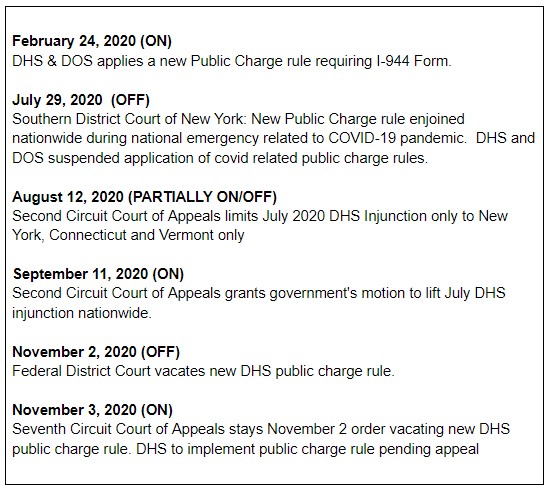
The “ON & OFF” Implementation of the Public Charge Rule

Share this:

For the last nine (9) months beginning on February 24, 2020, the implementation of the new public charge rules has been halted at least two times on July 29, 2020 and November 2, 2020.

As of this writing, the public charge rules are in effect and are implemented by the U.S. Citizenship and Immigration Services for all immigrant visa applicants and certain non-immigrant visas.

Applicants for immigrant visas have been confused by press releases on whether public charge rule applies and if they have to submit the Form I-944 in their applications for adjustment of status.

Below is a summary of the result of litigation and court rulings on the issue of public charge. The annotation ON and OFF are written to indicate whether the public charge rule was in effect. (ON means that they are implemented and OFF means the rules are suspended)

The United States and the rest of the world are still facing the challenges of a global pandemic. The harsh public charge rules have discouraged several immigrants from applying for public benefits that could prevent them from contracting or treating those who are already afflicted with COVID-19. With the coming new administration, it is our hope that these new public charge rules be suspended for the greater good of the community and in the interest of promoting public health.

Categories
Updates

Immigration Alert: Public Charge Rule Reinstated for Implementation

Share this:

On September 11,2020, the Second Circuit Court of Appeals overturned the New York federal judge’s order  blocking the Department of Homeland Security from denying permanent residency to legal immigrants who may have received certain public assistance in the wake of COVID-19 pandemic.

As a result, on September 22, 2020, the U.S. Citizenship and Immigration Services (USCIS) issued guidance on how it will implement the public charge rule (also referred to as the “wealth test”) that took effect on February 24, 2020.  According to USCIS, the following rules will now be implemented:

  • Approved Petitions/Applications: If as a result of the injunction case that was filed, USCIS approved applications and petitions without the required public charge form known as the Affidavit of Self Sufficiency (I-944), it will no longer open the case and re-adjudicate.
  • Pending Petitions/Applications: Those who filed petitions or applications before October 13, 2020 and who did not attach the Affidavit of Self Sufficiency Form, a Request for Evidence (RFE) will be issued by the USCIS to afford the petitioner or applicant to submit the I-944 form.
  • Petitions/Applications Filed On or After October 13, 2020 without I-944 form will be rejected by USCIS.
  • On Non-immigrant Visa Petitions or Applications: USCIS also indicated it will ask for any missing evidence for Form I-129, Petition for a Nonimmigrant Worker; Form I-129CW, Petition for a CNMI-Only Nonimmigrant Transitional Worker; Form I-539, Application to Extend/Change Nonimmigrant Status; and Form I-539A, Supplemental Information for Application to Extend/Change Nonimmigrant Status.

Applications for Immigrant and non-immigrant visas may be denied based on findings that the visa applicant is more likely than not to be a public charge.

While there are added restrictions to the new public charge rules, there are also exemptions. The final public charge rule excludes: public benefits received by individuals who are serving in active duty or in the Ready Reserve component of the U.S. armed forces, and their spouses and children; public benefits received by certain international adoptees and children acquiring U.S. citizenship; Medicaid for aliens under 21 and pregnant women; Medicaid for school-based services (including services provided under the Individuals with Disabilities Education Act); and Medicaid benefits for emergency medical services.; applicants seeking asylum, certain U and T visa applicants and self petitioner’s based on Violence Against Women’s Act (VAWA).

With the harsh ruling by the Second Circuit Court of Appeals, the intending immigrants and even their U.S. citizens or legal permanent residents will be seriously impacted. And during this pandemic, the impossible choice, according to U.S. District Judge George Daniels, whose decision was overturned, will be between jeopardizing public health/personal safety and immigration status. Until a new law is passed or the Supreme Court rules on this issue, the public charge rules implemented on February 24, 2020 stands.

(Updated as of September 23, 2020)

( Lourdes S. “Atty.Lou” Tancinco is an immigrant advocate and legal counsel based in San Francisco CA. She is the principal and co-founder of Tancinco Law Offices and  may be reached at law@tancinco.com, tancinco.weareph.com/old, LinkedIn, Facebook/tancincolaw, or at 1-888-930-0808)