Your authorized stay as a nonimmigrant is expired even if
You have timely filed an Application for Adjustment of Status (AOS) based on Spousal Petitions, Family and Employment-based Petitions and Asylum Applications!
“Over the past few days, AILA members have reported an increase in clients being detained by DHS at U.S. airports during domestic travel. This is occurring across the country, including in California, Colorado, Florida, Illinois, Kansas, Michigan, New Jersey, Texas, and Virginia.
Impacted individuals include those whose lawful status has expired but may have timely filed adjustment of status applications or asylum applications which would allow them to be in a period of authorized stay. Reports include individuals being detained who do not have criminal records and who have valid work authorization or advance parole documents.” (AILA Doc. No. 26072702)
If you have questions about your specific situation, please contact our office to schedule a consultation. We may be reached at 1 415 397 0808, law@tancinco.com or through our website: www.tancinco.com.
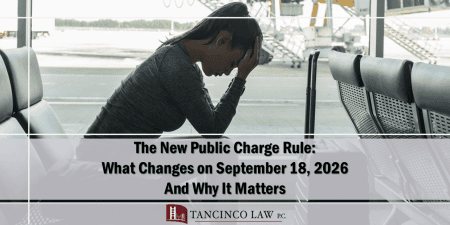
On July 16, 2026, the Department of Homeland Security finalized a rule rescinding the Biden administration’s 2022 public charge regulation. The change restores “Congressional intent that aliens in the United States be self-reliant.” For the roughly one million people who file Form I-485 each year to adjust status to lawful permanent residence, the change is significant— it reshapes one of the most consequential, and least predictable, tests in the green card process. Here’s what’s actually changing, who is likely to be affected by it, and why we anticipate that that this new public charge rule opens the door to inconsistent and potentially arbitrary decision-making.
What Is “Public Charge”?
Section 212(a)(4) of the Immigration and Nationality Act makes a person inadmissible — and therefore ineligible for a green card or visa — if they are deemed “likely at any time to become a public charge.” An application for immigrant visa through adjustment of status or consular processing may be denied if there is a finding that the applicant is likely to become a public charge. But what does public charge really mean? The term itself is not defined in the statute. Through USCIS regulations and case precedents, it has been defined, redefined, and litigated over for more than a century, most dramatically during the last decade: a narrow Clinton-era definition, a sharply expanded 2019 Trump-era rule (blocked in courts and later withdrawn), and then the 2022 Biden rule that restored the narrower, pre-2019 approach. The 2026 Trump rule now rescinds that 2022 framework — but unlike its predecessors, it doesn’t replace it with a new detailed definition. It simply removes the guardrails.
The 2022 Rule: A Narrow, Defined Test
To understand the change, let’s revisit the Biden’s 2022 Rule which is rescinded. Under the 2022 rule, “public charge” meant a very specific thing: someone likely to become primarily dependent on the government for subsistence. That dependence could only be shown two ways:
Receipt of public cash assistance for income maintenance — programs like SSI or TANF, and
Long-term institutionalization at government expense.
Everything else was off the table. Medicaid, SNAP (food stamps), housing assistance, and other non-cash or supplemental benefits could not be counted against the visa applicant.
Benefits received by other household members didn’t count against the applicant either. The rule also explicitly declined to designate any single factor as “heavily weighted,” and it built in defined exemptions and procedural clarity — applicants and attorneys knew, with reasonable confidence, what would and would not be scrutinized.
The 2026 Rule: Discretion Without a Defined Standard
The new rule strips out the 2022 framework in its entirety — the definition, the structured list of considered benefits, and the codified exemptions and waivers. In their place, USCIS is directed to conduct a “totality of the circumstances” review using the statutory factors already listed in the INA: age, health, family status, financial resources, and education/skills. Key changes:
No more “primarily dependent” standard. Officers are no longer bound to a specific dependency threshold; they can weigh any factor they consider relevant to self-sufficiency.
Any means-tested benefit is fair game. Rather than limiting review to cash assistance and institutionalization, officers may now consider receipt of any means-tested public benefit — including non-cash programs like Medicaid or SNAP — received on or after the rule’s effective date.
No replacement definition. DHS isn’t issuing a new detailed rule to take the 2022 rule’s place. Adjudicators will rely on the bare statutory language, past precedent decisions, and “policy guidance” the agency has not yet released.
A revised Form I-485. USCIS will publish a new version of the form; older versions submitted or postmarked on or after September 18, 2026, will be rejected outright.
Tougher bond terms. Any public charge bond posted on or after the effective date will be considered breached if the bonded individual receives any means-tested benefit before death, permanent departure, or naturalization — or is otherwise found noncompliant with bond conditions.
Affidavit of Support unchanged. Form I-864 remains required for most family-based and some employment-based cases, and will continue to factor into the totality-of-circumstances review.
Statutory exemptions remain. Refugees, asylees, Special Immigrant Juveniles, and T/U nonimmigrant and VAWA beneficiaries, among others, are still statutorily exempt from public charge review.
Who Is Likely to Be Affected
The people most exposed under the new framework are those the 2022 rule was specifically designed to protect:
Lower- and middle-income applicants adjusting status through family sponsorship, whose households may have used Medicaid, SNAP, or housing assistance at some point — benefits that were previously irrelevant to their case and now may not be.
Applicants with elderly, disabled, or chronically ill family members, since health and prior institutional care can again be weighed more heavily.
Mixed-status and mixed-benefit households, where a US citizen child’s use of Medicaid or SNAP could indirectly color an officer’s view of the household’s overall financial self-sufficiency, even though the applicant themselves isn’t the benefit recipient.
Employment-based applicants in lower-wage occupations or with large families, where income-to-household-size ratios may be scrutinized more subjectively.
Anyone who used benefits in the gap period before new guidance is issued — since DHS has not clarified how reliance on the 2022 rule’s protections between now and September 18 will be treated going forward.
Steps to Consider Now
1. File before September 18, 2026, if you’re eligible and ready. If your case is otherwise complete, filing under the current 2022 framework may be advantageous, since the new discretionary standard won’t apply to applications filed before the effective date.
2. Use the correct Form I-485 version. Once USCIS publishes the revised form, older versions submitted on or after the effective date will be rejected outright — confirm you’re using the current version before filing.
3. Review your household’s benefit history with your attorney. If anyone in your household — including the applicant — has received means-tested benefits, discuss now how that history might be viewed under the new standard, and whether documentation of eligibility, need, or duration should be prepared in advance.
4. Prepare a well documented Affidavit of Support. Since Form I-864 remains a required and heavily weighed factor, ensure sponsors meet income thresholds and have documentation ready, since financial evidence will matter even more under a broader discretionary review.
5. Don’t disenroll from benefits your household is legally exempt from or entitled to without professional advice first. Fear-driven withdrawal from benefits — especially for exempt categories like US citizen children — can create financial hardship without necessarily improving your case; talk to an immigration attorney before making that decision.
6. Watch for USCIS policy guidance. As interim guidance is released ahead of September 18, revisit your case strategy — the practical scope of “totality of the circumstances” will become clearer as that guidance is published.
7. Consult an immigration attorney about timing and evidence strategy specific to your case. Because outcomes under the new rule may vary based on individual officer discretion, a case-specific risk assessment is more valuable now than ever.
More Scrutiny on Green Card Applications
The new rule means broad USCIS officer discretion with no clear replacement standard. It is anticipated that there will be closer scrutiny of benefits use, more requests for evidence and less certainty about how any two cases-even similar ones-will be decided. If ready and eligible it is advisable to file adjustment applications before the effectivity date. However, careful attention should be given to reviewing your case against the May 21, 2026 policy on adjustment of status before filing.
If you have questions about how this ruling affects your family’s specific situation, please contact our office to schedule a consultation. We may be reached at 1 415 397 0808, law@tancinco.com or through our website: www.tancinco.com.
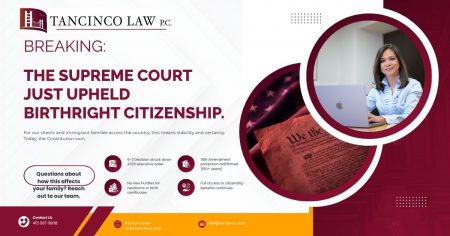
Today, June 30, 2026, in a major victory for immigrant families and for every child born on U.S. soil, the U.S. Supreme Court today struck down President Trump’s executive order that sought to end automatic citizenship at birth — including for children of undocumented or temporary-status parents, but also more broadly for every child born in the United States.
The Court ruled 6-3 that the executive order violated the Citizenship Clause of the 14th Amendment, a guarantee that has applied to virtually all babies born here, regardless of their parents’ status, for more than 150 years.
The Court Ruling
The case, Trump v. Barbara, was brought by the ACLU and several civil rights organizations on behalf of families who would have been affected by the executive order, which the President signed on his first day in office in 2025. Lower courts had blocked Trump’s executive order from ever taking effect, and today’s ruling makes that block permanent and nationwide.
Writing for the majority, Chief Justice John Roberts affirmed that the 14th Amendment’s guarantee of citizenship to “all persons born … in the United States” applies to virtually every child born here, regardless of their parents’ immigration status. The decision relies on the Court’s landmark 1898 ruling in United States v. Wong Kim Ark, which has anchored birthright citizenship law for well over a century.
What This Means for Our Community
This is welcome and important news for immigrant families. In practical terms, the ruling means:
Citizenship at birth is unchanged. A child born in the United States — regardless of their parents’ visa status, asylum status, or lack of documentation — remains automatically a U.S. citizen at birth, exactly as before.
Birth certificates remain valid proof of citizenship. Families do not need to navigate any new federal eligibility process, database check, or additional paperwork to establish a newborn’s citizenship.
Continued access to citizenship-dependent benefits, including Social Security numbers and passports, without new immigration-status screening for parents.
A strong constitutional precedent reaffirmed. The ruling reinforces that this protection comes from the Constitution itself, not a statute Congress can simply rewrite.
That said, as noted below, the President has signaled he intends to keep pushing on this issue, so it’s worth staying informed.
What’s Next?
We want to be candid with our clients: this fight is not necessarily over. President Trump has urged Congress to legislate around the ruling, and the decision was not unanimous — three justices dissented. We will continue to monitor any legislative or legal developments closely and will update you immediately if anything changes that affects your family’s situation.
For now, today’s decision preserves more than 150 years of settled law and constitutional protection for every child born on American soil.
If you have questions about how this ruling affects your family’s specific situation, please contact our office to schedule a consultation. We may be reached at 1 415 397 0808, law@tancinco.com or through our website: www.tancinco.com.
We use cookies on our website to give you the most relevant experience by remembering your preferences and repeat visits. By clicking “Accept”, you consent to the use of ALL the cookies.
This website uses cookies to improve your experience while you navigate through the website. Out of these, the cookies that are categorized as necessary are stored on your browser as they are essential for the working of basic functionalities of the website. We also use third-party cookies that help us analyze and understand how you use this website. These cookies will be stored in your browser only with your consent. You also have the option to opt-out of these cookies. But opting out of some of these cookies may affect your browsing experience.
Necessary cookies are absolutely essential for the website to function properly. This category only includes cookies that ensures basic functionalities and security features of the website. These cookies do not store any personal information.
Any cookies that may not be particularly necessary for the website to function and is used specifically to collect user personal data via analytics, ads, other embedded contents are termed as non-necessary cookies. It is mandatory to procure user consent prior to running these cookies on your website.