For non-citizens with visa overstays, pending/final orders of removal, unexecuted deportation warrants, or past convictions:
1. Air Travel Transmits Advance Passenger Data Airlines are required to submit passenger manifests to DHS before flight departure. Interceptions by ICE or CBP are typically triggered by flight booking data, not the camera scan at the gate.
2. Acceptable Identification Matters If traveling domestically, non-citizens must present an unexpired state driver’s license (if REAL ID compliant), a valid foreign passport, or a DHS-issued ID (such as Form I-766 Employment Authorization Card or Form I-551 Green Card). Presenting suspicious or invalid documents raises scrutiny.
3. High-Risk Zones Airports located within 100 miles of a U.S. border or international entry hub feature higher concentrations of active border patrol and ICE personnel.
4. Legal Consultation Is Essential Non-citizens with unexecuted removal orders or severe status discrepancies should consult a qualified immigration attorney prior to booking domestic or international air travel.
Know Your Rights at the Airport: If questioned regarding your immigration status at a domestic security checkpoint, you have the right to remain silent, request to speak with an attorney, and decline to sign any immigration documents without legal counsel.
If you have questions about your specific situation, please contact our office to schedule a consultation. We may be reached at 1 415 397 0808, law@tancinco.com or through our website: www.tancinco.com.
Your authorized stay as a nonimmigrant is expired even if
You have timely filed an Application for Adjustment of Status (AOS) based on Spousal Petitions, Family and Employment-based Petitions and Asylum Applications!
“Over the past few days, AILA members have reported an increase in clients being detained by DHS at U.S. airports during domestic travel. This is occurring across the country, including in California, Colorado, Florida, Illinois, Kansas, Michigan, New Jersey, Texas, and Virginia.
Impacted individuals include those whose lawful status has expired but may have timely filed adjustment of status applications or asylum applications which would allow them to be in a period of authorized stay. Reports include individuals being detained who do not have criminal records and who have valid work authorization or advance parole documents.” (AILA Doc. No. 26072702)
If you have questions about your specific situation, please contact our office to schedule a consultation. We may be reached at 1 415 397 0808, law@tancinco.com or through our website: www.tancinco.com.
On July 16, 2026, the Department of Homeland Security finalized a rule rescinding the Biden administration’s 2022 public charge regulation. The change restores “Congressional intent that aliens in the United States be self-reliant.” For the roughly one million people who file Form I-485 each year to adjust status to lawful permanent residence, the change is significant— it reshapes one of the most consequential, and least predictable, tests in the green card process. Here’s what’s actually changing, who is likely to be affected by it, and why we anticipate that that this new public charge rule opens the door to inconsistent and potentially arbitrary decision-making.
What Is “Public Charge”?
Section 212(a)(4) of the Immigration and Nationality Act makes a person inadmissible — and therefore ineligible for a green card or visa — if they are deemed “likely at any time to become a public charge.” An application for immigrant visa through adjustment of status or consular processing may be denied if there is a finding that the applicant is likely to become a public charge. But what does public charge really mean? The term itself is not defined in the statute. Through USCIS regulations and case precedents, it has been defined, redefined, and litigated over for more than a century, most dramatically during the last decade: a narrow Clinton-era definition, a sharply expanded 2019 Trump-era rule (blocked in courts and later withdrawn), and then the 2022 Biden rule that restored the narrower, pre-2019 approach. The 2026 Trump rule now rescinds that 2022 framework — but unlike its predecessors, it doesn’t replace it with a new detailed definition. It simply removes the guardrails.
The 2022 Rule: A Narrow, Defined Test
To understand the change, let’s revisit the Biden’s 2022 Rule which is rescinded. Under the 2022 rule, “public charge” meant a very specific thing: someone likely to become primarily dependent on the government for subsistence. That dependence could only be shown two ways:
Receipt of public cash assistance for income maintenance — programs like SSI or TANF, and
Long-term institutionalization at government expense.
Everything else was off the table. Medicaid, SNAP (food stamps), housing assistance, and other non-cash or supplemental benefits could not be counted against the visa applicant.
Benefits received by other household members didn’t count against the applicant either. The rule also explicitly declined to designate any single factor as “heavily weighted,” and it built in defined exemptions and procedural clarity — applicants and attorneys knew, with reasonable confidence, what would and would not be scrutinized.
The 2026 Rule: Discretion Without a Defined Standard
The new rule strips out the 2022 framework in its entirety — the definition, the structured list of considered benefits, and the codified exemptions and waivers. In their place, USCIS is directed to conduct a “totality of the circumstances” review using the statutory factors already listed in the INA: age, health, family status, financial resources, and education/skills. Key changes:
No more “primarily dependent” standard. Officers are no longer bound to a specific dependency threshold; they can weigh any factor they consider relevant to self-sufficiency.
Any means-tested benefit is fair game. Rather than limiting review to cash assistance and institutionalization, officers may now consider receipt of any means-tested public benefit — including non-cash programs like Medicaid or SNAP — received on or after the rule’s effective date.
No replacement definition. DHS isn’t issuing a new detailed rule to take the 2022 rule’s place. Adjudicators will rely on the bare statutory language, past precedent decisions, and “policy guidance” the agency has not yet released.
A revised Form I-485. USCIS will publish a new version of the form; older versions submitted or postmarked on or after September 18, 2026, will be rejected outright.
Tougher bond terms. Any public charge bond posted on or after the effective date will be considered breached if the bonded individual receives any means-tested benefit before death, permanent departure, or naturalization — or is otherwise found noncompliant with bond conditions.
Affidavit of Support unchanged. Form I-864 remains required for most family-based and some employment-based cases, and will continue to factor into the totality-of-circumstances review.
Statutory exemptions remain. Refugees, asylees, Special Immigrant Juveniles, and T/U nonimmigrant and VAWA beneficiaries, among others, are still statutorily exempt from public charge review.
Who Is Likely to Be Affected
The people most exposed under the new framework are those the 2022 rule was specifically designed to protect:
Lower- and middle-income applicants adjusting status through family sponsorship, whose households may have used Medicaid, SNAP, or housing assistance at some point — benefits that were previously irrelevant to their case and now may not be.
Applicants with elderly, disabled, or chronically ill family members, since health and prior institutional care can again be weighed more heavily.
Mixed-status and mixed-benefit households, where a US citizen child’s use of Medicaid or SNAP could indirectly color an officer’s view of the household’s overall financial self-sufficiency, even though the applicant themselves isn’t the benefit recipient.
Employment-based applicants in lower-wage occupations or with large families, where income-to-household-size ratios may be scrutinized more subjectively.
Anyone who used benefits in the gap period before new guidance is issued — since DHS has not clarified how reliance on the 2022 rule’s protections between now and September 18 will be treated going forward.
Steps to Consider Now
1. File before September 18, 2026, if you’re eligible and ready. If your case is otherwise complete, filing under the current 2022 framework may be advantageous, since the new discretionary standard won’t apply to applications filed before the effective date.
2. Use the correct Form I-485 version. Once USCIS publishes the revised form, older versions submitted on or after the effective date will be rejected outright — confirm you’re using the current version before filing.
3. Review your household’s benefit history with your attorney. If anyone in your household — including the applicant — has received means-tested benefits, discuss now how that history might be viewed under the new standard, and whether documentation of eligibility, need, or duration should be prepared in advance.
4. Prepare a well documented Affidavit of Support. Since Form I-864 remains a required and heavily weighed factor, ensure sponsors meet income thresholds and have documentation ready, since financial evidence will matter even more under a broader discretionary review.
5. Don’t disenroll from benefits your household is legally exempt from or entitled to without professional advice first. Fear-driven withdrawal from benefits — especially for exempt categories like US citizen children — can create financial hardship without necessarily improving your case; talk to an immigration attorney before making that decision.
6. Watch for USCIS policy guidance. As interim guidance is released ahead of September 18, revisit your case strategy — the practical scope of “totality of the circumstances” will become clearer as that guidance is published.
7. Consult an immigration attorney about timing and evidence strategy specific to your case. Because outcomes under the new rule may vary based on individual officer discretion, a case-specific risk assessment is more valuable now than ever.
More Scrutiny on Green Card Applications
The new rule means broad USCIS officer discretion with no clear replacement standard. It is anticipated that there will be closer scrutiny of benefits use, more requests for evidence and less certainty about how any two cases-even similar ones-will be decided. If ready and eligible it is advisable to file adjustment applications before the effectivity date. However, careful attention should be given to reviewing your case against the May 21, 2026 policy on adjustment of status before filing.
If you have questions about how this ruling affects your family’s specific situation, please contact our office to schedule a consultation. We may be reached at 1 415 397 0808, law@tancinco.com or through our website: www.tancinco.com.
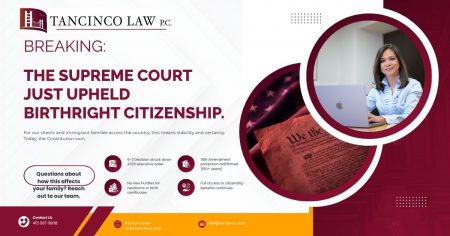
Today, June 30, 2026, in a major victory for immigrant families and for every child born on U.S. soil, the U.S. Supreme Court today struck down President Trump’s executive order that sought to end automatic citizenship at birth — including for children of undocumented or temporary-status parents, but also more broadly for every child born in the United States.
The Court ruled 6-3 that the executive order violated the Citizenship Clause of the 14th Amendment, a guarantee that has applied to virtually all babies born here, regardless of their parents’ status, for more than 150 years.
The Court Ruling
The case, Trump v. Barbara, was brought by the ACLU and several civil rights organizations on behalf of families who would have been affected by the executive order, which the President signed on his first day in office in 2025. Lower courts had blocked Trump’s executive order from ever taking effect, and today’s ruling makes that block permanent and nationwide.
Writing for the majority, Chief Justice John Roberts affirmed that the 14th Amendment’s guarantee of citizenship to “all persons born … in the United States” applies to virtually every child born here, regardless of their parents’ immigration status. The decision relies on the Court’s landmark 1898 ruling in United States v. Wong Kim Ark, which has anchored birthright citizenship law for well over a century.
What This Means for Our Community
This is welcome and important news for immigrant families. In practical terms, the ruling means:
Citizenship at birth is unchanged. A child born in the United States — regardless of their parents’ visa status, asylum status, or lack of documentation — remains automatically a U.S. citizen at birth, exactly as before.
Birth certificates remain valid proof of citizenship. Families do not need to navigate any new federal eligibility process, database check, or additional paperwork to establish a newborn’s citizenship.
Continued access to citizenship-dependent benefits, including Social Security numbers and passports, without new immigration-status screening for parents.
A strong constitutional precedent reaffirmed. The ruling reinforces that this protection comes from the Constitution itself, not a statute Congress can simply rewrite.
That said, as noted below, the President has signaled he intends to keep pushing on this issue, so it’s worth staying informed.
What’s Next?
We want to be candid with our clients: this fight is not necessarily over. President Trump has urged Congress to legislate around the ruling, and the decision was not unanimous — three justices dissented. We will continue to monitor any legislative or legal developments closely and will update you immediately if anything changes that affects your family’s situation.
For now, today’s decision preserves more than 150 years of settled law and constitutional protection for every child born on American soil.
If you have questions about how this ruling affects your family’s specific situation, please contact our office to schedule a consultation. We may be reached at 1 415 397 0808, law@tancinco.com or through our website: www.tancinco.com.
On May 21, 2026, U.S. Citizenship and Immigration Services (USCIS) issued Policy Memorandum PM-602-0199 — a directive that immediately triggered alarm headlines across the country. Media reports declared that green card applicants would now have to “go back to their countries” to obtain their visas. Immigration advocates characterized it as the latest in a series of attacks on legal immigrants. And USCIS’s own press release invoked language far harsher than anything in the memo itself.
As immigration attorneys at the Tancinco Law P.C., our job is to cut through the noise. Here is what this policy memorandum actually does, what it does not do, who it affects — and why, despite real concern, this is not the time to give up.
Understanding Adjustment of Status
For those unfamiliar with the term, adjustment of status is the process by which a non-immigrant — someone already physically present in the United States on a temporary visa — applies for a green card without having to leave the country. It is one of two pathways to lawful permanent residence; the other is consular processing at a U.S. Embassy or Consulate abroad.
Three common examples illustrate how it works:
• A visitor visa holder within authorized stay meets a U.S. citizen, they marry, and the U.S. citizen petitions their spouse. The nonimmigrant spouse may adjust status to that of a green card holder from within the United States.
• A foreign student on an F-1 visa graduates, is recruited by a U.S. company, and secures an employment-based visa petition. The student may then adjust status based on the approved petition without departing the country.
• A parolee who entered the U.S. on humanitarian grounds is petitioned by a U.S. citizen parent. The parolee may generally apply for adjustment of status and obtain a green card in the United States.
What makes adjustment complicated is when the applicant has fallen out of status. Under existing law, those who have fallen out of status are generally not permitted to adjust status inside the United States — with important exceptions: when the petition is filed by a U.S. citizen immediate relative (spouse, parent, or child), or when specific statutory grounds for waiver of unlawful status exist, such as Section 245(i) of the Immigration and Nationality Act.
What the Memo Actually Says — and What It Does Not
The policy memorandum, PM-602-0199, reaffirms that adjustment of status is a discretionary benefit under Section 245(a) of the Immigration and Nationality Act. It instructs USCIS officers to treat that discretion as a live, meaningful inquiry — not a rubber stamp — and to weigh all positive and negative factors in each case.
Critically, the law itself — Section 245(a) — does not use the words “extraordinary relief” or “act of grace.” The statute says that status “may be adjusted by the Secretary, at his discretion.” The characterization of adjustment as extraordinary relief derives from Board of Immigration Appeals (BIA) decisions and federal court rulings cited throughout the memo, not from the text of the law itself. This distinction matters enormously for any future legal challenge.
WHAT THE MEMO DOES SAY:
Directs adjudicating immigration officers to weigh all relevant positive and negative factors taking into account totality of circumstances
Consider violations of immigration law (e.g. staying beyond authorized stay), fraud, failure to depart and conduct inconsistent with visa status as adverse factors
Applicants have the burden of proof in demonstrating positive equities noting that a clean record is not enough
Denials of Adjustment Applications by USCIS officers must be in writing with a specific analysis of why negative outweigh positives
WHAT THE MEMO DOES NOT DO
It does not amend or repeal INA § 245 or any regulation
It does not eliminate any green card eligibility category
It does not direct applicants to abandon U.S.-based filings and go through consular processing.
It does not override statutory protections for immediate relatives or 245(i) beneficiaries.
It explicitly states it may not be relied upon to create any right or remove immigration officer’s discretion.
The Press Release vs. The Policy: A Critical Distinction
Much of the panic generated by this memo stems not from the memo itself, but from how USCIS chose to announce it. The USCIS’ press release used the phrase that USCIS “will grant Adjustment of Status only in extraordinary circumstances” — language that does not appear anywhere in the body of PM-602-0199.
Nowhere in the policy memorandum does USCIS direct applicants for adjustment of status to go through consular processing. The memo is unambiguous on this point: it “is intended solely for the guidance of USCIS personnel in the performance of their official duties” and “does not remove their discretion in making adjudicatory decisions.”
If a case is meritorious and there are genuine equities, the policy memo clearly requires the adjudicating officer to look at the totality of the circumstances — not apply an “extraordinary circumstances” standard as the press release implied. Green card applications remain a case-by-case determination. The existence of a negative factor does not mean discretion must automatically bite.
A Filipino Case, a Buried Dissent, and an Uncanny Warning for Today
What few observers have noted is that the foundational case cited throughout this policy memo — Matter of Blas, 15 I&N Dec. 626 (BIA 1974) — involves a Filipino national. Pedro Blas was a Philippine citizen married to a U.S. citizen whose application for adjustment of status was denied by an immigration judge on discretionary grounds, with findings of fraud and misrepresentation in his nonimmigrant visa application.
The majority of the Board affirmed the denial. But the dissenting opinion of BIA Chairman Roberts deserves far more attention than the majority ruling — because it anticipated, with remarkable precision, the exact danger that unchecked discretionary authority poses today.
“Unless some objective standards are laid down for the exercise of administrative discretion, decisions could be based on our own unfettered and subjective notions. An intolerant immigration judge could deny relief to aliens whose cultural patterns, moral standards, or lifestyle differed from his own. A hostile or xenophobic immigration judge could vent his spleen on aliens he personally considered offensive without articulating the actual basis for his decision.”
— BIA Chairman Roberts, dissenting, Matter of Blas (1974)
That warning — issued over fifty years ago in a case involving a Filipino applicant — is precisely what concerns us about this new policy guidance. The memo quotes Matter of Blas extensively for the proposition that adjustment is discretionary. What it does not quote is Chairman Roberts’ prescient caution against the dangers of exactly that discretion exercised without objective standards.
For the Filipino community — and indeed for all immigrant communities of color — this history is not abstract. It is a reminder of how easily discretionary authority, if left unchecked, can become a vehicle for the very bias that immigration law is supposed to prevent.
Who Are Most Affected?
The memo’s practical impact will be felt most acutely by three populations:
• Overstays and status violations. Nonimmigrants who overstayed or violated status — tourist visa holders, F-1 students who fell out of status, and others who remained beyond authorized periods. These factors now weigh heavily at the discretionary stage, even where the underlying petition is valid and approvable.
• Dual-intent visa holders. Even H-1B and other dual-intent visa holders are not automatically insulated. The memo acknowledges dual intent as permissible but makes clear that maintaining lawful status alone is not sufficient to guarantee a favorable exercise of discretion.
• Parolees. Parolees — particularly those who entered under CHNV and similar humanitarian parole programs. USCIS frames the act of remaining to adjust, rather than departing when the parole purpose ends, as an adverse factor. This is a direct concern for many Filipino beneficiaries of humanitarian parole programs.
On the other side, applicants with strong positive equities — U.S. citizen family members, U.S. citizen children, long records of tax compliance, stable employment, and deep community ties — remain well-positioned if their case is properly presented. The key is documentation and advocacy, not silence. In this climate, a complete record and a compelling argument are not optional. These are everything.
The Legal Landscape: Will Courts Push Back?
This is not the first time this administration has used policy memoranda to reshape immigration adjudication — and it is not the first time the courts have been called to respond. In a recent Northern District of Illinois case (No. 26 C 2389), a federal judge granted a temporary restraining order against USCIS, blocking the application of earlier 2025–2026 policy memos to a pending I-485 on the grounds that the policy violated the Administrative Procedure Act (APA). That case provides a roadmap.
PM-602-0199 is strategically drafted to be harder to challenge. By grounding every denial in “discretion,” USCIS is invoking the shield of Patel v. Garland (2022), in which the Supreme Court held that federal courts lack jurisdiction to review factual findings in discretionary relief proceedings. In other words, if USCIS calls it a discretionary judgment, courts may not be able to second-guess the individual outcome.
However, the legal community has identified several vulnerabilities in this policy:
• The immediate relative problem. The memo creates a tension that may be legally indefensible for immediate relatives of U.S. citizens — a group Congress explicitly protected from many of the Section 245(c) bars. USCIS may not be able to reimpose at the discretionary stage what Congress deliberately removed at the eligibility stage.
• APA rulemaking requirements. Because the memo does not go through notice-and-comment rulemaking, a pattern of denials following its directives could be challenged under the APA as arbitrary and capricious agency action — not as attacks on individual decisions, but on the policy itself.
• The denial notice requirement is a double-edged sword. The memo’s own requirement that discretionary denials include a written analysis of positive and negative factors creates a paper trail. Inconsistent, inadequately reasoned, or pattern denials of similarly-situated applicants become evidence in any class action or broad challenge.
A TRO or nationwide injunction against PM-602-0199 is unlikely immediately — the memo seems too carefully drafted to existing case law for a facial challenge to succeed today. The more probable path is a series of as-applied challenges once denials accumulate, particularly in cases of immediate relatives and lawfully-present employment-based applicants where the legal tension is sharpest.
Our Assessment: Do Not Give Up — But Do Not Wait
Despite all the policy pronouncements, regulatory changes, and executive orders of this administration — the attacks on birthright citizenship, the arrests in immigration courts, the revocations of naturalization — there are always judicial avenues to defend rights and uphold the Constitution. That principle holds here.
PM-602-0199 is a significant development. It is not a death sentence for adjustment of status cases. But it is a clear signal that the era of filing and waiting is over. Every I-485 must now be argued — not just assembled. Every application must anticipate the discretionary question and answer it affirmatively, with evidence, before the officer even asks.
WHAT THIS MEANS FOR YOUR CASE — ACTION STEPS
1. Document your positive equities comprehensively.
U.S. citizen or LPR family members, U.S. citizen children, years of tax compliance, community ties, employment history, and hardship factors must all be in the record — not assumed.
2. Address negative factors proactively.
Overstays, status lapses, or prior violations should be explained, contextualized, and offset — not left for the officer to discover and weigh alone.
3. If denied, demand the written analysis — and use it.
The memo requires written reasons for discretionary denials. An inadequate or pretextual denial notice is both appealable and evidence in any broader legal challenge.
4. Consult legal counsel immediately.
If you have a pending I-485 or are planning to file, a full case review under this new standard is essential — before USCIS conducts its own.
(Atty. Lourdes Santos Tancinco, Esq. is a San Francisco based immigration attorney of Tancinco Law, P.C. an immigrant rights advocate . She may be reached at 1 888 930 0808, law@tancinco.com or facebook.com/tancincolaw, or through her website www.tancinco.com)
We use cookies on our website to give you the most relevant experience by remembering your preferences and repeat visits. By clicking “Accept”, you consent to the use of ALL the cookies.
This website uses cookies to improve your experience while you navigate through the website. Out of these, the cookies that are categorized as necessary are stored on your browser as they are essential for the working of basic functionalities of the website. We also use third-party cookies that help us analyze and understand how you use this website. These cookies will be stored in your browser only with your consent. You also have the option to opt-out of these cookies. But opting out of some of these cookies may affect your browsing experience.
Necessary cookies are absolutely essential for the website to function properly. This category only includes cookies that ensures basic functionalities and security features of the website. These cookies do not store any personal information.
Any cookies that may not be particularly necessary for the website to function and is used specifically to collect user personal data via analytics, ads, other embedded contents are termed as non-necessary cookies. It is mandatory to procure user consent prior to running these cookies on your website.